AMANAH RESEARCH — NORTHEAST OHIO PROPERTY INTELLIGENCE
Where Cleveland Breathes
The Legal, Environmental, and
Strategic Future of Shaker Lakes
One park, 130 years of legal history, two contested dams, a lease expiring in 2040, and a conservation leader with a vision that may determine the future of Northeast Ohio's most beloved urban sanctuary.
Amanah Consulting & Investments LLC · Independent Research · July 2026
The Shaker Lakes Parklands comprise approximately 279 acres of urban greenspace at the intersection of Cleveland, Shaker Heights, and Cleveland Heights. They are ecologically significant, historically irreplaceable, and legally complex. An 1895 deed restriction, a reversionary interest conveyed in 1913 to a company that dissolved in 1959, a municipal lease expiring in 2040, and a contested dam removal decision are converging simultaneously — creating a moment of unusual strategic importance for the park's future. This article presents Amanah's independent analysis of that moment. It was prepared without compensation and without the involvement or review of any party associated with the Shaker Lakes Parklands or the Nature Center at Shaker Lakes.
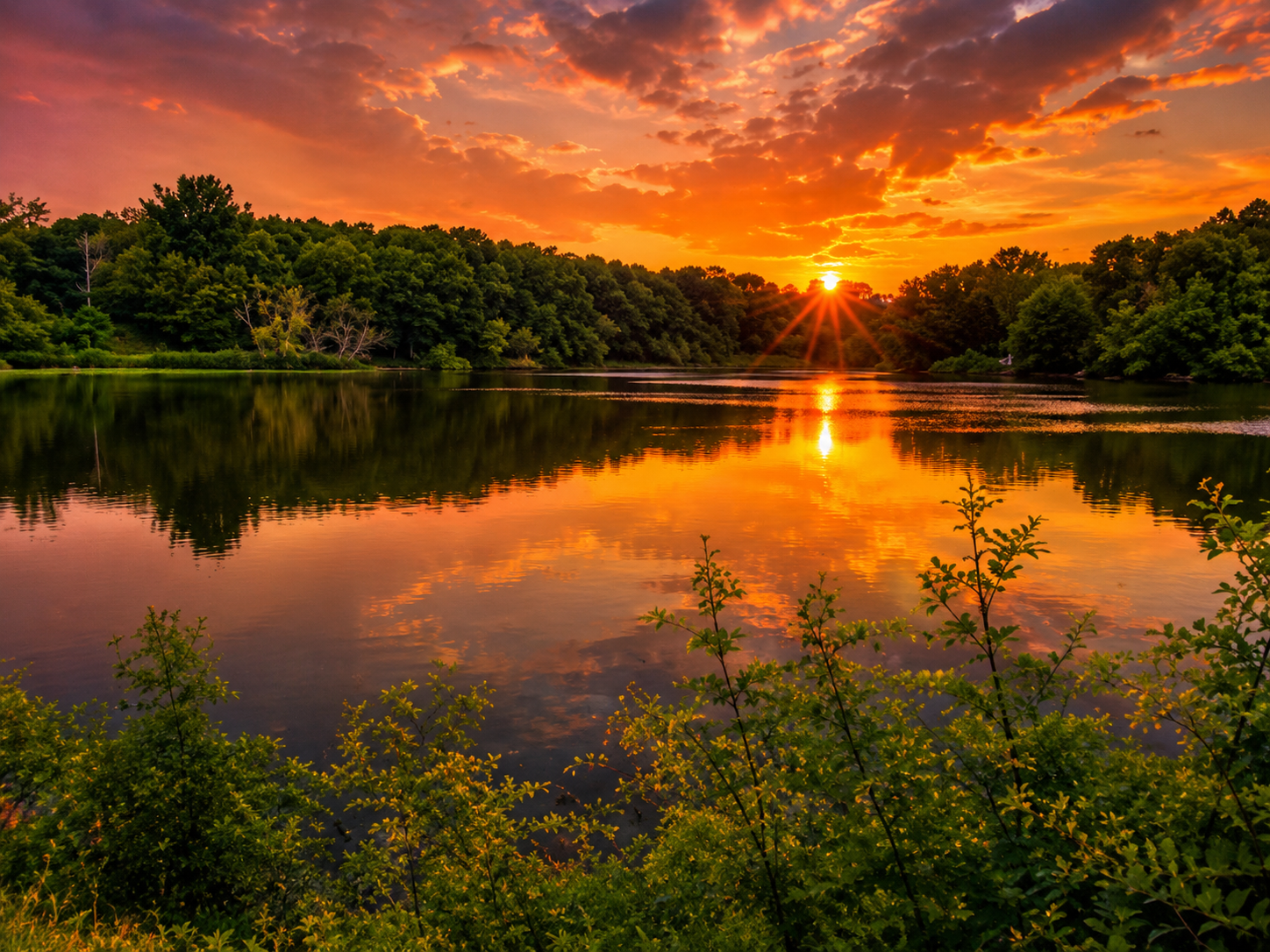
There is something that happens when you walk through Shaker Lakes at sunset. The light comes through the canopy in long shafts that catch the water and the boardwalk planks. The sounds of the city drop behind you. Your breath slows. Something loosens that you did not realize was held tight. This is where Cleveland comes to think. Where Northeast Ohio goes to breathe.
It is not an exaggeration to say that many of the best things that happen in this region have their origin here — in a walk through these trails at dusk, a conversation on a boardwalk, a moment of clarity beside still water. The park draws more than 140,000 visitors to the Nature Center alone every year. It is an Important Bird Area, a National Environmental Education Landmark, and the ecological heart of the Doan Brook watershed. But above all, it is a living piece of Northeast Ohio's soul.
Which is why what is happening to it right now matters — not just to birdwatchers and hikers, but to investors, developers, community leaders, attorneys, and anyone with a stake in the long-term health of the region's most compelling urban neighborhoods.
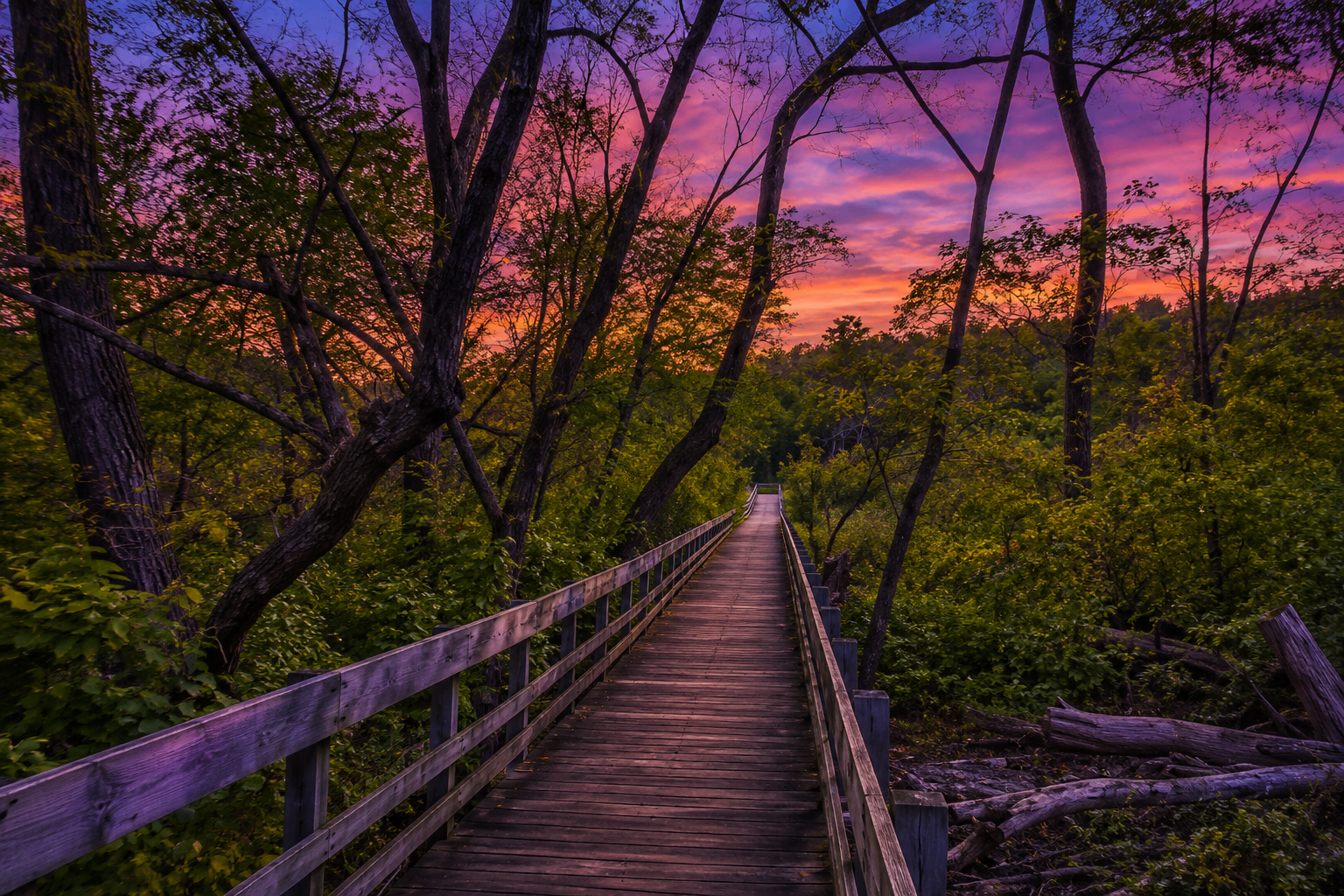
The boardwalks of Shaker Lakes connect the natural world to the neighborhoods that surround it — and have for generations.
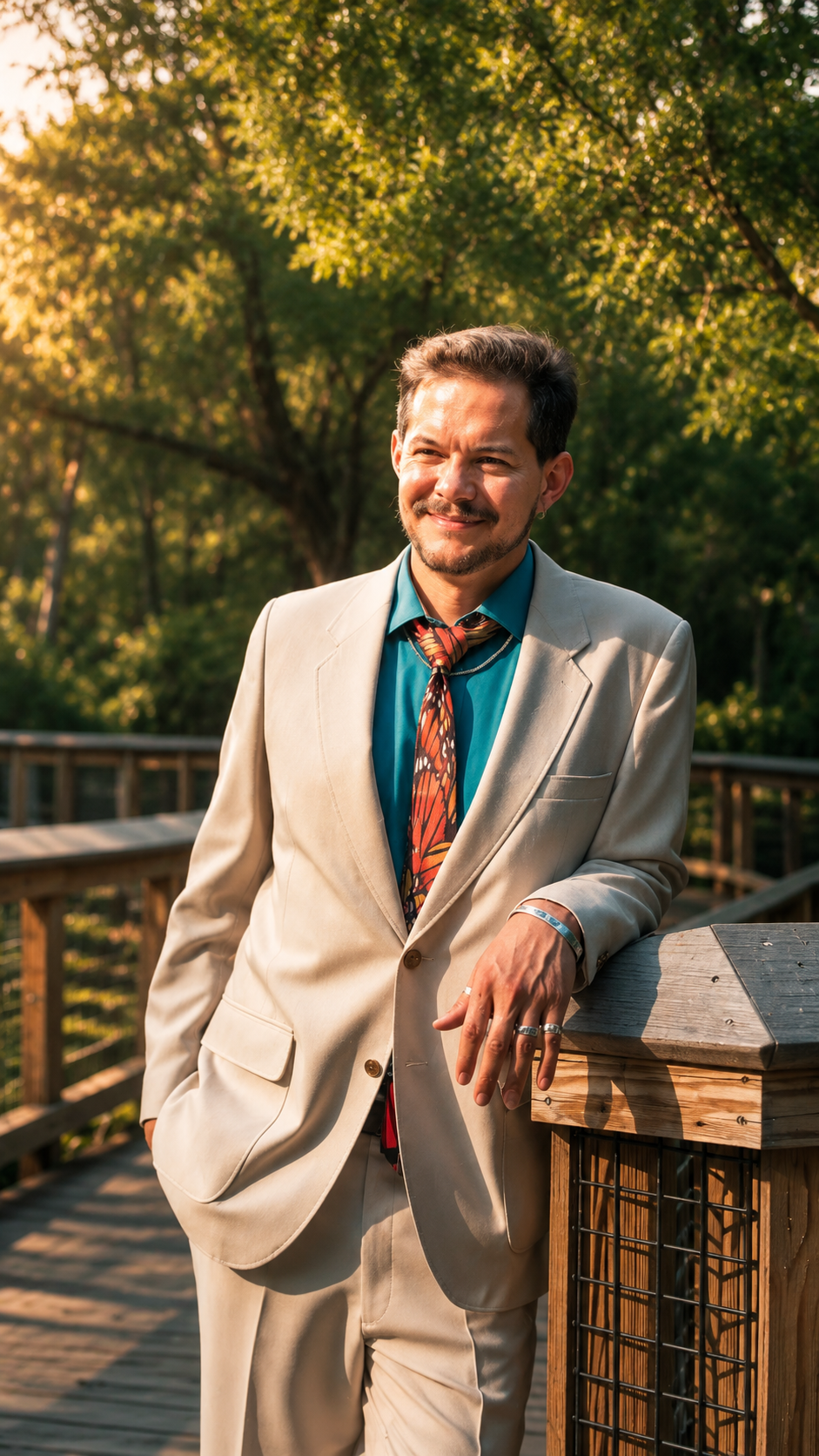
Peter Bode
President & CEO — Since May 2023
There is a kind of person who truly cares about the earth — and you can usually tell them by how they talk about it. Not in abstractions, but in specifics. The particular bend in a silted stream. The exact conditions that caused a wetland to degrade. The name of the hawk that nested here last spring. Peter Bode, who has led the Nature Center at Shaker Lakes since May 2023, is that kind of person. Down to earth in the most literal sense.
Bode holds a B.S. in Environmental Science from Cleveland State University, is a Certified Ecological Restoration Practitioner, and is a Qualified Data Collector for the Ohio EPA. Before joining the Nature Center, he served as Executive Director of Community Life Collaborative in Chagrin Falls and held senior roles at West Creek Conservancy. He was named to Crain's Cleveland Business 40 Under 40 in 2023. He grew up in North Royalton — which perhaps explains the precision with which he speaks about what water does when it moves, and when it doesn't.
His vision for the Nature Center is ambitious: not "only a neighborhood nexus," he has said publicly, "but a regional hub." His passion for the environment, the land, and the people who live alongside it is evident from the first conversation. He is the kind of leader who makes you want to understand the problem more deeply before you respond — which is exactly what prompted this research.
"Your mission isn't in conflict with that restriction. It is the living embodiment of it."
Amanah's assessment of the "park purposes only" deed restriction and the Nature Center's mission
A Park Born from Generosity and Preserved by Resistance
In 1895, the Shaker Heights Land Company donated 279 acres of upper Doan Brook valley to the City of Cleveland with a single condition: the land must be used "for park purposes only." The two lakes within those acres — Lower Shaker Lake and Horseshoe Lake — had been created decades earlier by the North Union Shaker religious community, who dammed Doan Brook to power their mills. When the community dissolved in 1889, they left behind not just land, but water — and a landscape of unusual ecological depth.
In 1913, the Shaker Heights Land Company conveyed its reversionary interests in the property to the Van Sweringen Company — the development firm that would go on to build the planned community of Shaker Heights around the park's borders. The Van Sweringen Company went bankrupt following the brothers' deaths in 1935–1936, and after 23 years of reorganization proceedings, dissolved in approximately 1959.
In 1947, Cleveland leased the parklands to the cities of Shaker Heights and Cleveland Heights for the portions falling within their respective boundaries. That lease was renewed in 1990 for a primary term of 50 years — expiring in 2040 — with a right to extend for an additional 50 years. In 1966, a different kind of fight shaped the park's identity permanently. When the Ohio Department of Transportation proposed routing a freeway through the Shaker Lakes valley, the community's response was organized and effective. Advocates won the route's cancellation and incorporated the Shaker Lakes Regional Nature Center — negotiating a separate lease directly with the City of Cleveland for approximately 20 acres of the parklands. The freeway never came. The Nature Center did.
The Rockefeller Connection: A Precedent Written on the Land
The 1895 donation by the Shaker Heights Land Company did not happen in isolation. It was strategically timed to coincide with the construction of Rockefeller Parkway — a new road that would make the surrounding property more accessible and therefore more valuable for residential development. The donation of the parkland was, in part, a calculated move: give the watershed to Cleveland, and the road makes everything around it worth more.
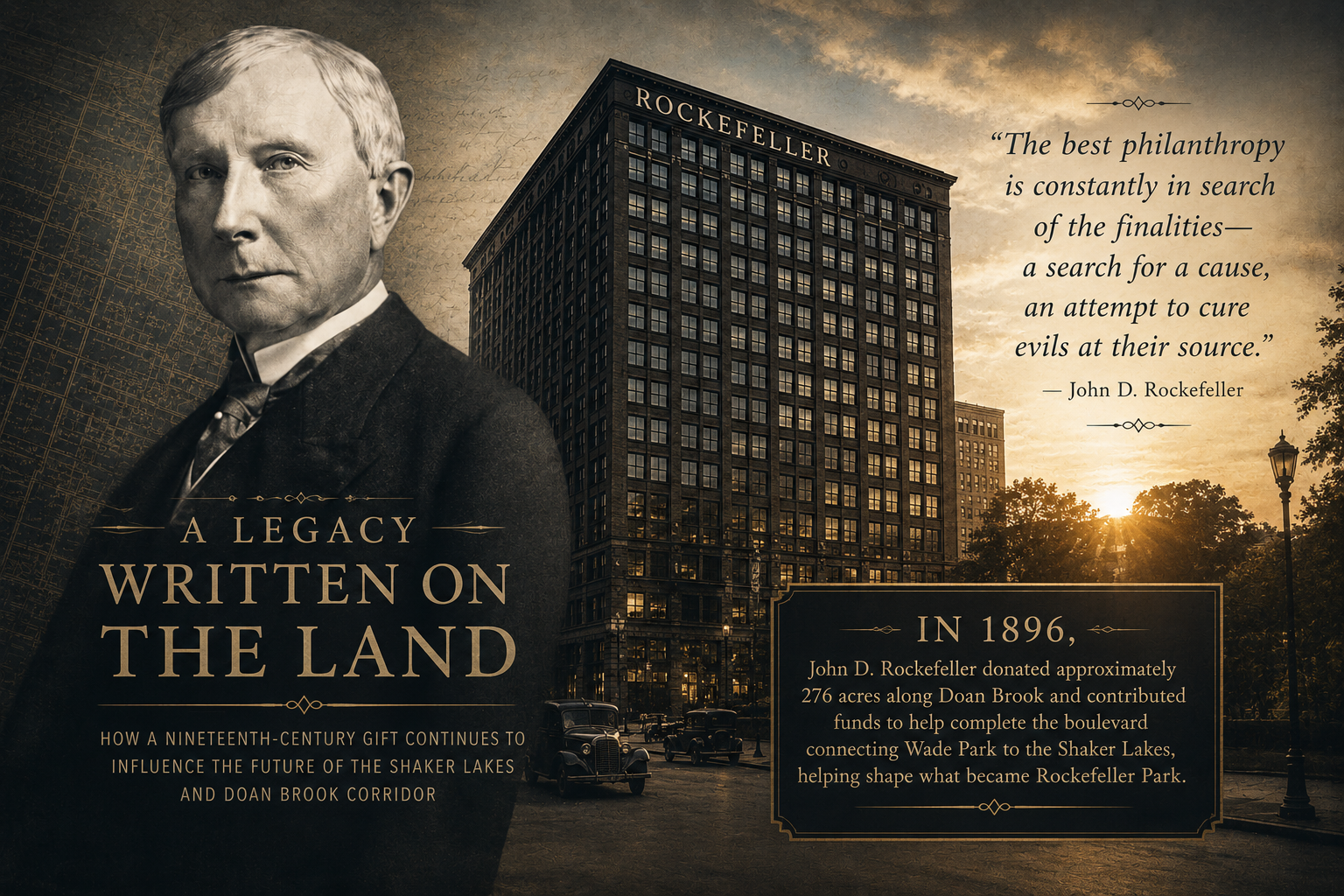
The following year, in 1896, John D. Rockefeller — then the wealthiest man in the United States — made his own gift: approximately 276 acres of land along Doan Brook, plus $300,000 in cash to help complete the boulevard connecting Wade Park to the Shaker Lakes. That single act of philanthropy completed the chain. From the Shaker settlement at the headwaters of Doan Brook all the way north to Lake Erie — Shaker Lakes, Ambler Park, Wade Park, Rockefeller Park, Gordon Park — the corridor became one unbroken thread of greenspace through Cleveland's urban fabric.
When Peter Bode references Rockefeller in conversation, he is drawing a deliberate line. This park was built by visionary private philanthropy working in concert with public ownership. That is not a historical curiosity — it is the operational blueprint for what could secure the Nature Center's next century. Major private capital has permanently shaped this landscape before. It can do so again.
Two Dams, One Decision Window, and a Rapidly Shifting Landscape
The Shaker Lakes Parklands are presently the subject of two parallel controversies, both involving decisions by the Northeast Ohio Regional Sewer District (NEORSD) regarding the two Shaker Lake dams.
Horseshoe Lake Dam: Proceeding
NEORSD determined the dam was non-compliant with Ohio dam safety standards and approved its removal. A $32 million project — with Shaker Heights and Cleveland Heights contributing approximately $7.1 million for park amenities — is currently underway. Construction will reshape more than 25 acres, remove more than 1,000 trees, and is expected to conclude in 2027. Legal challenges to halt the project were unsuccessful.
Lower Lake Dam: Contested
In July 2025, NEORSD changed its recommendation from reconstruction to removal, citing new engineering data, escalating cost estimates (rebuilding now estimated at $43–55 million), and a downstream culvert opportunity. The dam is a Class I High Hazard structure with emergency maintenance required in December 2025. As of July 2026, the project is in the permitting phase. The cities of Shaker Heights and Cleveland Heights have engaged legal counsel to review NEORSD's position.
Into this contested moment, Peter Bode has proposed a third path: raze the Lower Lake dam, but construct a new lake of at least 10 acres alongside the freed Doan Brook. NEORSD has indicated openness to exploring the concept. The Shaker Lakes Conservancy, formed in 2025–2026, has organized more than 700 participants and gathered more than 2,000 petition signatures in opposition to removal.
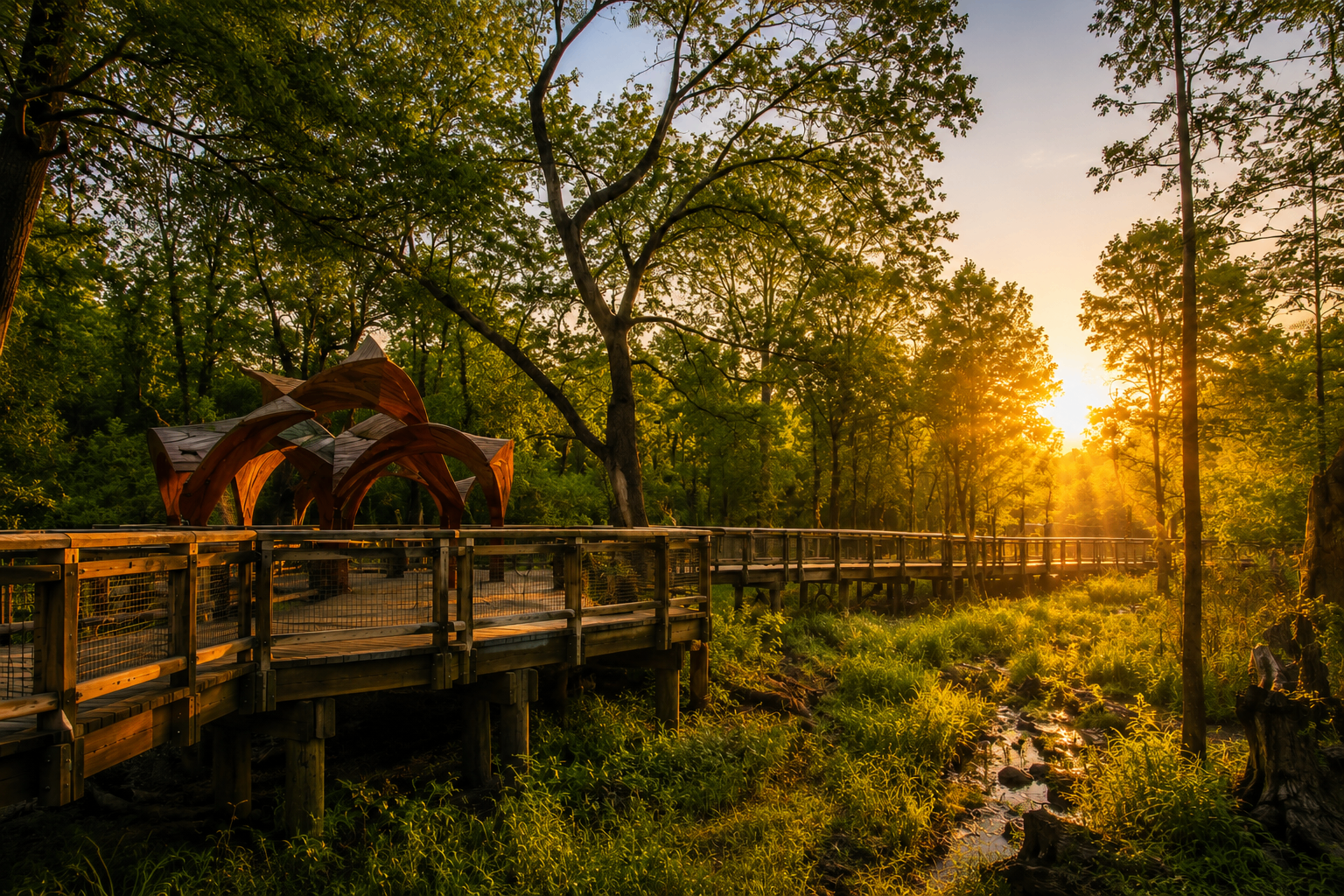
The Nature Center campus at golden hour — 20 acres held under a direct lease with the City of Cleveland since 1966.
What the Research Revealed: Six Key Findings
Amanah conducted extensive independent research into the property's 130-year ownership history, lease structure, applicable Ohio statutes, and strategic landscape. The following represents our analysis. None of it constitutes a legal opinion. All of it is offered for educational and informational purposes, as the foundation for informed professional inquiry.
The 1913 Van Sweringen reversionary interest has almost certainly been extinguished by Ohio's Marketable Title Act. Ohio enacted the Marketable Title Act (ORC §5301.47 et seq.) in 1961, extinguishing property interests more than 40 years old unless specific saving events occurred — by operation of law, requiring no court action. The Van Sweringen Company dissolved in approximately 1959. No public record indicates that anyone has ever filed a preservation notice. The Act's §5301.53 exceptions do not cover this type of private conditional estate interest. No private entity can claim this land.
The 'park purposes only' use restriction likely survives as an enforceable covenant — but without the forfeiture remedy. The reversionary interest (the right to reclaim the property) and the underlying use restriction are legally distinct. The use restriction is embedded in the foundational 1895 deed and is almost certainly referenced throughout the chain of title. It likely survives as a covenant enforceable by injunction. The practical difference: the land cannot be forfeited, but Cleveland remains obligated to use it for park purposes.
The 'park purposes only' restriction is an asset for the Nature Center's mission — not a barrier to it. The Nature Center's environmental education and conservation mission is precisely what 'park purposes only' was designed to protect. A long-term ground lease from the City of Cleveland to the Nature Center would be legally consistent with — and arguably required by — the underlying deed restriction. The restriction supports the arrangement, not obstructs it.
The Nature Center's direct lease with the City of Cleveland is its most important legal asset. Unlike the cities of Shaker Heights and Cleveland Heights, which hold leases from Cleveland, the Nature Center holds a direct lease with the fee owner. This creates institutional independence: the expiration of the suburban city leases in 2040 would not automatically terminate the Nature Center's rights. The NCSL has a direct channel to negotiate long-term institutional security with Cleveland.
The 50-year extension option in the 1990 lease appears not to have been exercised — and its deadline may be in the 2030–2035 timeframe. No public record references exercise of this option. The cities' recent engagement of legal counsel suggests lease terms are being examined now for the first time in years. If the deadline to exercise the option falls within a decade, this is an institutional planning urgency that has been significantly underappreciated in public discussion.
The optimal institutional structure is a long-term ground lease, not fee acquisition. Fee sale of public parkland is legally complex and politically untenable in this community. A 50-to-99-year ground lease from Cleveland to the Nature Center — paired with a conservation easement held by an independent third party and capitalized by philanthropic or impact investment — achieves long-term institutional security, satisfies the deed restriction, preserves public ownership, and creates a clear governance framework for any future campus expansion or new lake project.
"The new lake is not just a conservation compromise — it is the strategic equivalent of the Nature Center building itself in 1969. Create the alternative before the adverse outcome becomes irreversible."
Amanah Research, July 2026
Why Investors and Developers Should Be Watching
The Shaker Lakes Parklands are not, in the conventional sense, a real estate investment opportunity. The land is publicly owned, deed-restricted, and has no viable path to commercial development. But the situation has significant implications for the surrounding market — and for the future of impact and conservation investment in Northeast Ohio.
The neighborhoods that surround the parklands — the boulevard-lined residential streets of Shaker Heights and Cleveland Heights, the University Circle institutions to the northwest, the emerging corridors of Lee Road and Cedar Lee — derive meaningful value from proximity to this park. The parkland's physical character is therefore an economic variable affecting billions of dollars of surrounding residential and commercial real estate. The outcome of the Lower Lake dam decision will be priced into the neighboring market whether or not it is formally recognized.
For impact investors, conservation finance professionals, and mission- driven capital seeking environmental or community outcomes, the proposed new lake concept presents a potentially compelling structure: a capital-intensive project with measurable ecological outcomes, NEORSD co-funding potential, Ohio EPA grant eligibility, and a well-regarded nonprofit operator. The absence of a reversionary claimant — per the Marketable Title Act analysis — reduces the title risk profile considerably.
The adjacent development corridor tells a complementary story. Shaker Heights' Arcadia mixed-use development, Lee Road Action Plan, and Van Aken transit investments; Cleveland Heights' Marquee at Cedar Lee and Opportunity Zone incentives in the Caledonia Park area — these are active signals of a market investing in the residential and commercial infrastructure around this park. The park's long-term vitality is part of that investment thesis, whether developers are naming it explicitly or not.
Four Developments That Will Shape the Outcome
The Lower Lake Dam Decision
Physical deterioration of the dam is active and accelerating. Emergency maintenance was required in December 2025; a large tree near the dam split in May 2026. ODNR's authority to issue compliance orders is real and may be exercised within 2–4 years. The window for the new lake alternative closes with each month of delay.
The 2040 Lease Extension Option
The 1990 lease extension option may require exercise in the 2030–2035 timeframe. Whether it has been exercised — and if not, the deadline to do so — is the single most important unresolved institutional question for the park's future governance.
NEORSD's Response to the New Lake Concept
NEORSD has indicated openness to exploring Peter Bode's proposed new lake alongside the freed Doan Brook. Whether that interest translates into a letter of intent, an engineering study, or a funding commitment will determine whether the concept becomes a real alternative or remains a vision.
The Nature Center's Institutional Strategy
Whether the Nature Center pursues an expanded or extended lease with the City of Cleveland — potentially secured by a conservation easement and philanthropic capital — will determine whether the park has an institutional anchor capable of stewarding its next century.
A Lot of Good Things Start With A Walk Through This Park
Shaker Lakes is not just a park. It is a civic institution. It is ecological infrastructure. It is a gathering place for the kind of clarity that leads to good decisions — in business, in community, in life. Northeast Ohio has produced an unusual number of people who know this from personal experience: who took a run along its trails at dawn and came back with an answer they didn't have before, who had a conversation on its boardwalks that changed a direction, who sat by its water and found something they needed.
The park's future is not settled. The legal questions are real. The physical clock is running. The institutional gaps are significant. But the research suggests something encouraging: the path forward exists. The legal framework, properly understood, is not an obstacle to the Nature Center's mission — it is a structure that supports it. The community's passion is not an impediment to thoughtful decision-making — it is the fuel that has protected this place for 130 years.
Peter Bode's instinct — to build the lake rather than simply fight for the dam — reflects the same strategic wisdom that built the Nature Center in the first place. Amanah believes in his mission. We believe in the park. And we believe that with the right research, the right professionals, and the right structure, the best outcome is within reach.
That belief is why we did this work.
Next Step
Ready to Connect?
Whether you're buying, renting, listing a property, or joining the professional network — we'll help you get started.
Schedule a Consultation